
Chapter 1: Childhood memories
Margit mentioned in her book she and I didn’t have anything in common. That happens so many times with brothers and sisters. She liked to draw and paint pictures, which wasn’t encouraged at that time. No future in that. I didn’t like to draw or paint. She liked to play with dolls and make clothes for them. I wasn’t much for dolls.
My only other sister was Frieda Pauline, who was born when I was about two and a half years old. She wasn’t well and died when she was eight months old. Mother often talked about how sad it was to see her grab for the milk bottle. She was always hungry, but the doctor said to give her just two ounces of diluted milk with a little sugar in it at the time.
[Gunhild also had an older brother, Ole, and a younger brother, Halvor. –ed]
Life events
When I was three years old my dad had cut down trees on the farm and hauled the logs to Peterson, Minn. to be sawed into boards. He had a pile a couple feet high laying by the machine shed. Margit, Ole and I had fun climbing on top of the logs and jumping down. I got the brilliant idea, I would jump on my side and so I did and broke my arm above the wrist. This was about five o’clock in the afternoon so no way could we start out for Rushford and the doctor.
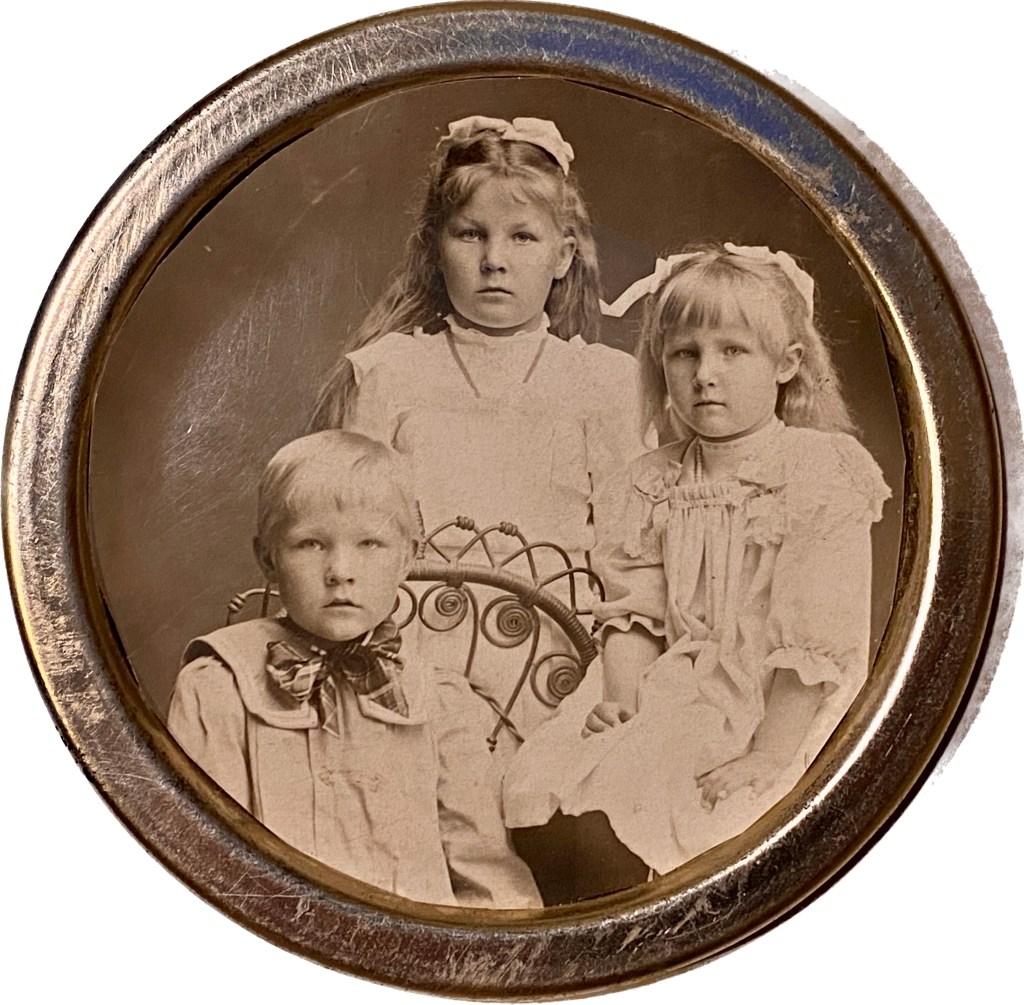
Gunhild (at right) with her older siblings
Margit and Ole.
I don’t remember anything about the ordeal until the next afternoon after we had been to see the doctor to have the arm set and the cast on. And we were sitting in the Rushford Lutheran Church. I dimly remember I was in lots of misery. It was the day my cousin Minda Benson got married to Oscar Holtegaard. I remember the bride and groom standing by the altar. She was dressed in a long white gown and a long white veil. I’m sure it was the first bride I had seen.
Nature lover
I loved nature. It was so wonderful to hear the birds sing. Robins in the spring, meadowlarks and later song sparrows, bobolinks, orioles, bluebirds, and many others. One thing I enjoyed was going to get the mail, a quarter mile away, between hay and cornfields. It was so good to hear the birds sitting on fence posts and trees, warbling along when we drove to town in the lumber wagon, or to church, in the buggy on Sunday mornings.
I miss the song birds. there aren’t nearly as many around anymore. It’s blamed on the DDT spraying along the highways and other places. All this spraying to kill weeds has been hard on the song birds.
I loved to go down in the woods and pick flowers in the spring. The hepaticas were the first. We called them mayflowers although many times they were out in April. I used to go down in the woods north of our place and look for the first ones. Sometimes I was too early, I couldn’t wait. The Dutchman’s breeches came later and honeysuckles and violets and many others.
Mother had three beautiful big geraniums in the South window in the kitchen. Red, white and pink.
Music to my ears
My mother sang Norwegian hymns while she was ironing clothes or patching things. One was Jesus din sode forening at smage (“Jesus I Long for Thy Blessed Communion”) in the hymnbook. And once in a while Dad would walk the floor in the evening and sing, Jeg Ved et Evigt Himmerig. It wasn’t in our synodens hymn book but was in the one he brought from Norway. Translated it is “I know of an Everlasting Heaven”.
One of my fondest memories was hearing my dad play the Jewish harp in the evening. Sometimes he also made flutes from aspens, pussy willow trees, the right size. When he could find one with a straight trunk two or three feet from the ground, the trees would be four to six feet tall. in the spring when the sap started flowing he’d cut it about two feet long and slip the bark off the trunk and make a flute. He made a plug of the trunk, two or three inches, with a blow hold and he would hold the other end and use his finger for playing a tune.
He’d play a tune sometimes at noon when he was home for dinner, mostly in the evening after work. The flute had to be kept damp so the bark wouldn’t crack. The tones of these homemade flutes were so beautiful, it was softer and mellower than metal instrument music.
When Dad saw I was interested in music he bought a second hand organ at a neighbors auction. I was eleven or twelve, I guess. This stood in the parlor. It was there I practiced my lessons. The parlor wasn’t heated in winter so there were some very cold fingers at times, but it was worth it. I enjoyed it. My teacher got married when I had taken 14 lessons, but I learned enough so I could play some hymns and school songs and waltzes.
Household art
Dad was very good at wood carving and had painted a picture of his home in Norway and also a picture of Mother’s parent’s home in Norway. A wood box carved in beautiful scrolls was one foot long and about eight inches along the side and three inches high, made for keepsakes. This later was given to the Norwegian Museum in Decorah, Iowa. A newspaper holder that hung next to the kitchen clock on the south wall of the kitchen, with a carved front and the top of the back with red flannel inserted between the two pieces of a triangle to make room for newspapers. He also carved kubbestols and sold several.
He carved a round box with a cover, about eight inches across with the inscription “Helga 1911” for Mother. Dad also made an early American style parlor table the first years after they were married. On it stood their beautiful parlor lamp on a green felt table runner Mother made and Dad painted a picture on both ends. Beautiful. And a picture album on the shelf below. The parlor wasn’t used except when we had company.
Work around the house
We weren’t allowed to grow up on the lazy side. As soon as we were old enough to go to school, at least, we were called early. Mother would call up the stairs, “Naa maa de up, klokka gaar te sju.” (You have to get up, the clock is going toward seven.) This would be just a few minutes after six. I started to school when I was a few months over five years old.
We usually had the Saturday’s work done up before dinner. Then after dinner we had a rule to learn, a commandment or a few questions in the explanation book. Every evening after school we had to read our next week’s religious lesson over three times — so it would be easier to learn on Saturday. This before we could do other jobs or go out to play a while.
Margit and I had our jobs on Saturday morning. One was scrubbing the unpainted wooden kitchen chairs and washing the lamp chimneys and filling the lamps with kerosene. And changing and making the beds upstairs and sweeping the floors and changing the paper on pantry shelves, besides washing floors. O yes, a weekly job on Saturday was polishing the knives and forks we used for everyday. We had a piece of brick on a wooden board and we would scrape off some and wet a rag and dip it in the scrapings and polish the tin part of the knives and forks and spoons. It worked like magic.
School days
We grew up in a very Norwegian neighborhood. Only two families’ children could talk English when they started to school. We learned to read in a Norwegian ABC book so had to start from scratch in English when we started to school.
Going to school was three fourths mile across the fields facing the Northwest wind. So in the winter our hands and feet were mighty cold by the time we got there. There was a register in the middle of the room and on cold mornings the school house was too cold to sit in our seats, we were all allowed to crowd around the register until it warmed up a little. When I started to school there were close to forty students for a few years.
We boarded the teacher off and on. It wasn’t easy to be a school teacher in those days either. And from what I hear it isn’t easier now. The ruler across the fingers was one punishment. That was for the big boys who didn’t mind.
Harvesting strawberries
I must have been seven years old when we had a big patch of strawberries south of the house on the field next to the cow pasture where there was a big oak tree. A good place for Halvor, 9-10 months old, to take his nap while the rest of us were picking strawberries. And who would dream the sun would find a space to peep through to his face. When we came to pick him up his face was sun burned, but there were no ill effects.
Mother charged seen cents a quart that year, 1909. Later we had half an acre farther away from the house on new soil that had just been cleared. Mother charged ten cents at that time and we sold a hundred dollars worth. People would come from miles around with pails and boxes to carry them. Some would bring their families along for the ride and mother always treated everyone to a dish of strawberries with sugar.
Next: Chapter 2: Coming of Age
 Margit Mindrum