Of course a farmer’s wife knows what a cow looks like
<< | Paintings | >>
Margit included cows in her paintings more often than pigs. Maybe she considered cows more photogenic. Or cows hung out in picturesque fields more than in muddy pens. Sheep rarely made an appearance outside of religious paintings (see The Lord is my shepherd).
- ID: ____
- Details: ” / Orig price: __ / Initial owner: ___
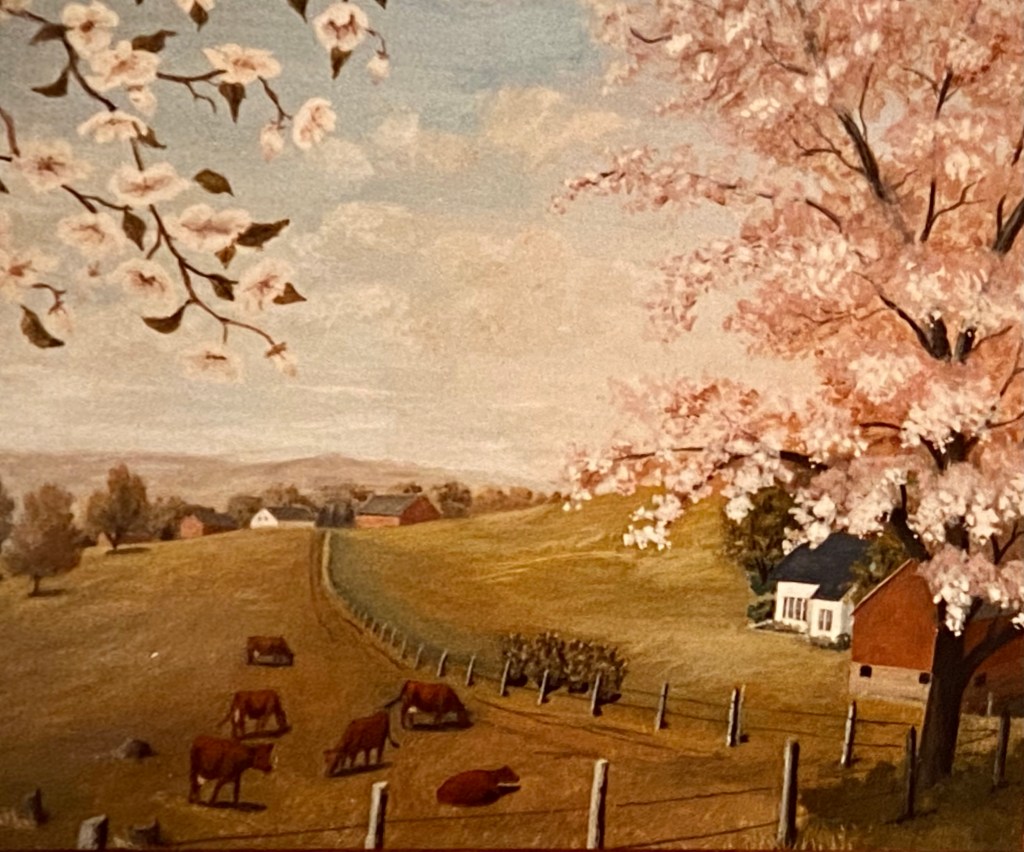
In this spring scene, the cows are positioned where Margit had sometimes shown a horse-drawn plow (see Spring plowing). Although the layout could resemble an existing farm, this painting lacks the believability of the scenes like “Yucatan Valley”.

- ID: 63-05 “Pasture & Cattle”
- Details: 16″ x 20″ / Orig price: $5 / Initial owner: A Dahl
This painting is sometimes called “Yucatan Valley”. Here the hills look like those around Margit’s Houston County. And the absence of a pond is believable too.
- ID: 68-18 “Farm stead storm”
- Details: 16″ x 24″ / Orig price: $10 / Initial owner: L Peterson
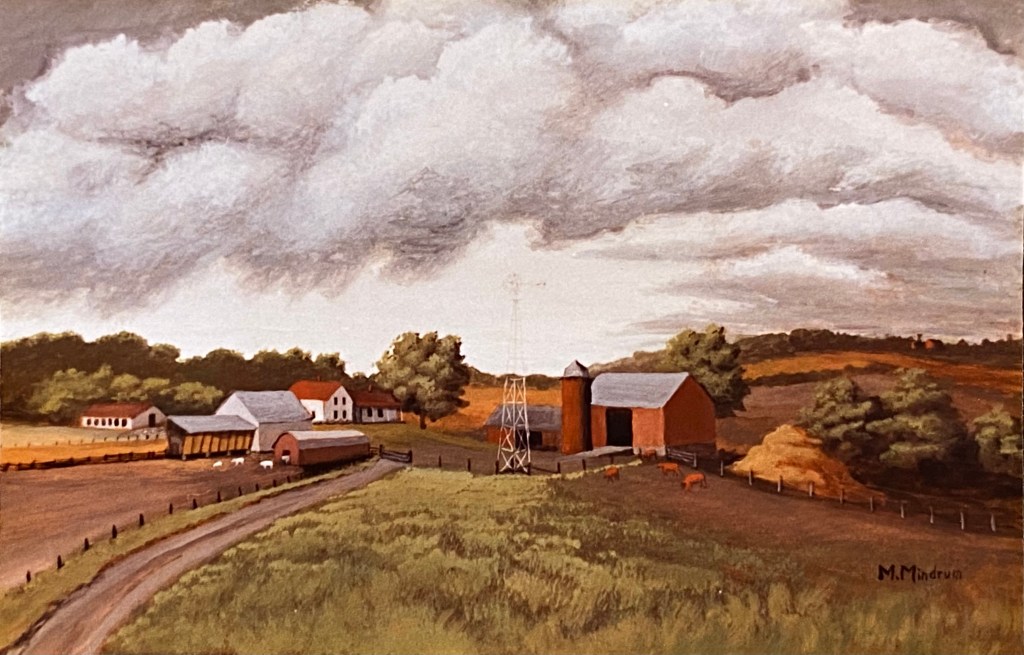
This painting gets its title from the weather, not the livestock. But if you look closely you can see (L to R) chickens, pigs, and cows—all sticking close to the “safety” of their shelters.
- ID: 69-09 “herford cattle”
- Details: 16″ x 20″ / Orig price: $10 / Initial owner: E Wilson
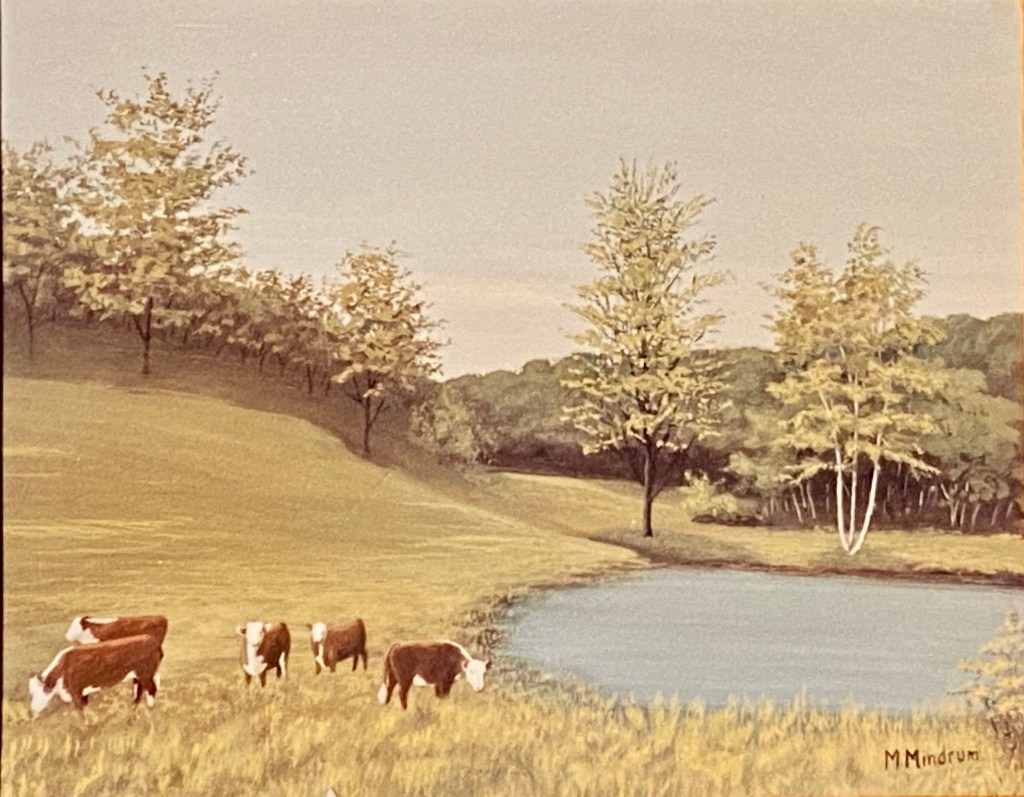
The lack of any farm buildings, or even a fence, in a farm scene is rare among Margit’s works. Here it makes the animals appear almost feral.
Dr. Marion Nelson says of the previous painting:
The Hereford cattle… catch the character of a Houston area meadow in a way that could be possible only after long experience with it. Even when copying a photograph, which could be the case here, Margit conveys a greater feeling of the scene than the camera can capture.
Three Landsverks, 1990
 Margit Mindrum