
My Brothers and Sisters
A brother called Ole
born November 19, 1901
A bouncing ten pound baby came to make his home with us when I was two years and nine months. He was named Ole Godtfred. I remember Mother saying he grew fast and was always hungry. She was afraid to feed him all he wanted. Sometimes she had to get up at night and cook milk mush for him. He wasn’t satisfied with plain milk.
That summer a brand new Quick Meal range had been installed in our kitchen. The little black iron stove was moved into the shed shanty where Mother cooked during the summer months. The first memory I have of the new range was sitting on the floor holding baby brother, looking at our reflection in the bright nickel trimmed oven door.
Other improvements were made. The unfinished upstairs was plastered and the little sitting room was furnished with an all over wool carpet and some additional furniture. Father and Mother were one of the first on Highland Prairie to install a telephone when a line was extended from Rushford Central forming a party line of around 20 shareholders in our neighborhood.
A sister called Gunhild
born January 30, 1903
I was four years old and Ole 14 months when a little sister called Gunhild Bertine came to our home. I was told that Mrs. Engh, the midwife, brought her in her little black satchel.
For another perspective on these years, see Gunhild’s story.
A short time after Gunhild was born Bestefar (Grandfather) Landsverk came to live with us.
How I liked to sit on his lap and comb his long white beard. He would stroke my hair and mumble God’s blessings for his little girl. I remember watching him eat his mush, always using his own special wooden spoon.
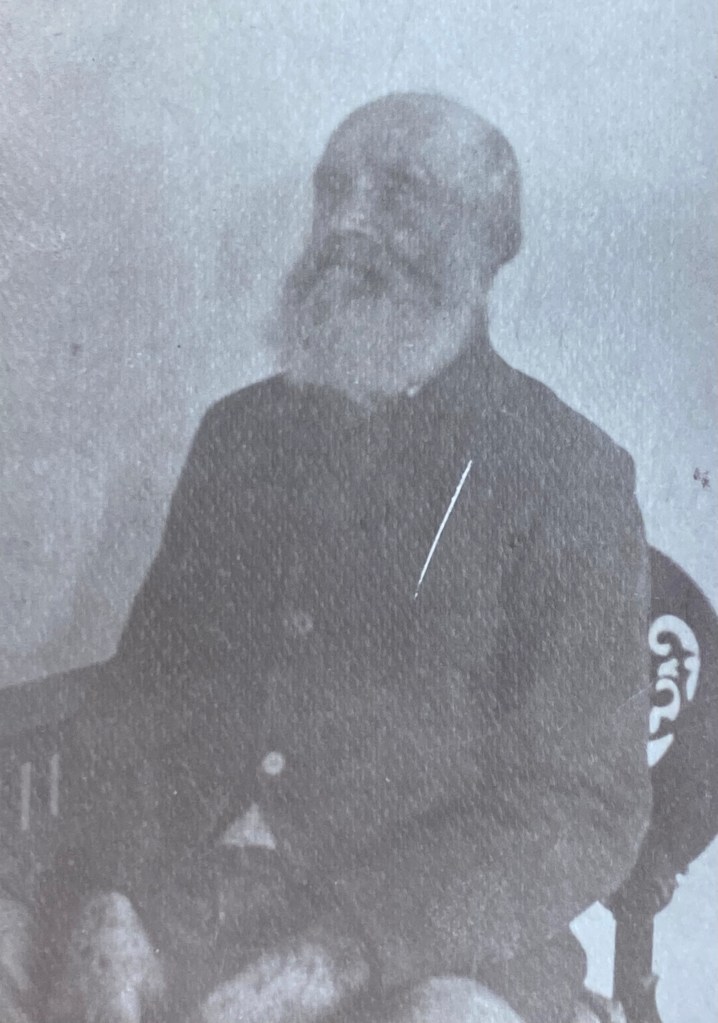
Halvor Landsverk
I only faintly remember when he got sick and had to stay in bed. Mother wasn’t feeling well so Grandpa had to be moved to his daughter Anne Rue’s place about three-fourths mile from our home. Aunty Anne was a widow and lived alone. About this time her sister, Margit Aasen, also a widow, had come to America. She helped Aunty Anne take care of Grandpa.
A sister called Frieda
born October 28, 1904
Soon after Grandpa moved from our place we got another little sister. She was named Frieda Pauline. When Frieda was two months old we went to see Grandpa. He was in bed and very weak. How happy and important I felt when allowed to carry baby sister over to the bed to show her to Grandpa. He smiled and said, “This little one will soon follow me.” The people around said he was feverish and not very clear. He passed away a few days later. I was around six years old.
When Frieda was seven months old, she suddenly got convulsions. The doctor didn’t understand what caused it. He told Mother to feed her only two ounces of barley water every three hours. She got thin and hungry. (Not until I had children of my own did I realize how Father and Mother must have suffered to see her smile and reach quickly for the bottle with only two ounces of weak barley water.) She died when she was nine months. It was hard on Mother. Not so much because Frieda passed away, but the memory of her hungry little form. Mother lost her voice and could only whisper for many months.
In the Fillmore County register of deaths for 1905, Frieda’s death is recorded next to her grandfather’s.

The summer after Frieda passed away Mother really went into the strawberry business. Neighbors from far and near ordered from 14 to 40 quarts. Mother always treated those who came to get the berries to a big dish of strawberries and sugar.
By this time Father and Mother had added another forty acres to their farm. Now they had one hundred acres. The cow herd had increased. Father had built a log stable that had room for seven cows and five calves. He also built an adjoining hay shed and a granary. Father had given up most of his carpentering for other people but he made good use of his carpenter tools by adding a young stock stable and horse barn for a team of young horses he named King and Prince. The log house was now used for a chicken coop.
How happy and carefree we were when we were small. Gunhild was cute with a happy mischievous smile. I was even a little jealous at times when I seemed to sense how especially proud Mother and Father were of her quick ways and bright sayings. Father and Mother would laughingly tell a story about Ole. I was having trouble mashing my potatoes into the gravy. Suddenly the fork slipped off and splashed gravy over Ole’s face. He only smiled through the gravy and said, “Ho e sterk, Margit.” (Margit is strong.)
When we were quite small we used to run under the stairway to pout on the cellar opening. It was our “furte kro.” (pouting corner) Once when Ole felt he was unjustly corrected he ran for the cellar door and landed in the cellar. The door had been left open. When I was older I had the same experience while playing hide and seek. When I tried to call for help, not a sound came out. I was sure I was dead.
I was proud to be the big sister that must help take care of my chubby brother and dainty little sister. How excited and proud I was when Ole was big enough to come along to visit school. I could hardly wait until we reached school. I can see him as if it were yesterday; dressed in a red homemade blouse and short trousers, with his snow white hair. As we finally reached the school house all the children, especially the girls, crowded around to see and hear this brother they had heard so much about.
During recess the big boys had climbed up in the attic and had coaxed Ole to hold on to the bell rope. They had pulled him almost to the high ceiling when the teacher noticed it. She hurriedly climbed on top of the teacher’s desk trying to reach him while she ordered the boys to lower him very slowly.
The next summer both Ole and I went to parochial school. One day mother and Father took Gunhild to the doctor in Lanesboro. They told us to come right home from school. If they had not returned, we should run over to Staalands one quarter mile away. Just as we came into the house a storm broke loose with loud thunder crashes. The rain poured down. We were scared. We agreed that we must pray God to take care of us. We had been taught at parochial school that we should kneel when we pray. So we both knelt in front of the sewing machine and asked God to take care of us and to stop the storm. Before we even finished, the rain stopped, the clouds parted and soon the sun shone on a wet but beautiful world as we ran barefoot across the field to Staalands. And no doubt was in my heart but that God had stopped the storm because we prayed.
I had many little problems that seemed very big at that time. One incident occurred on the first day of my second year at school. There was a new teacher and maybe I was afraid to talk. Anyway she put me in the beginners’ class, so the first recess I started for home crying. On the way home I met Ole Mindrum, a neighbor. He stopped his horses and after some coaxing I confided in him. He would take me back to school and talk to the teacher. I dried my tears as over the road his fast horses went and a terrible mistake was prevented. A few years later when I heard that he had suddenly passed away, I admit I shed my first tears of real sorrow because I felt the loss of a good friend and neighbor.
In another year, Gunhild joined us and skipping and dancing we all three were on our way to school. I was sometimes provoked at Gunhild. If there were any news to tell, Gunhild could outrun me and would always reach home first to tell it.
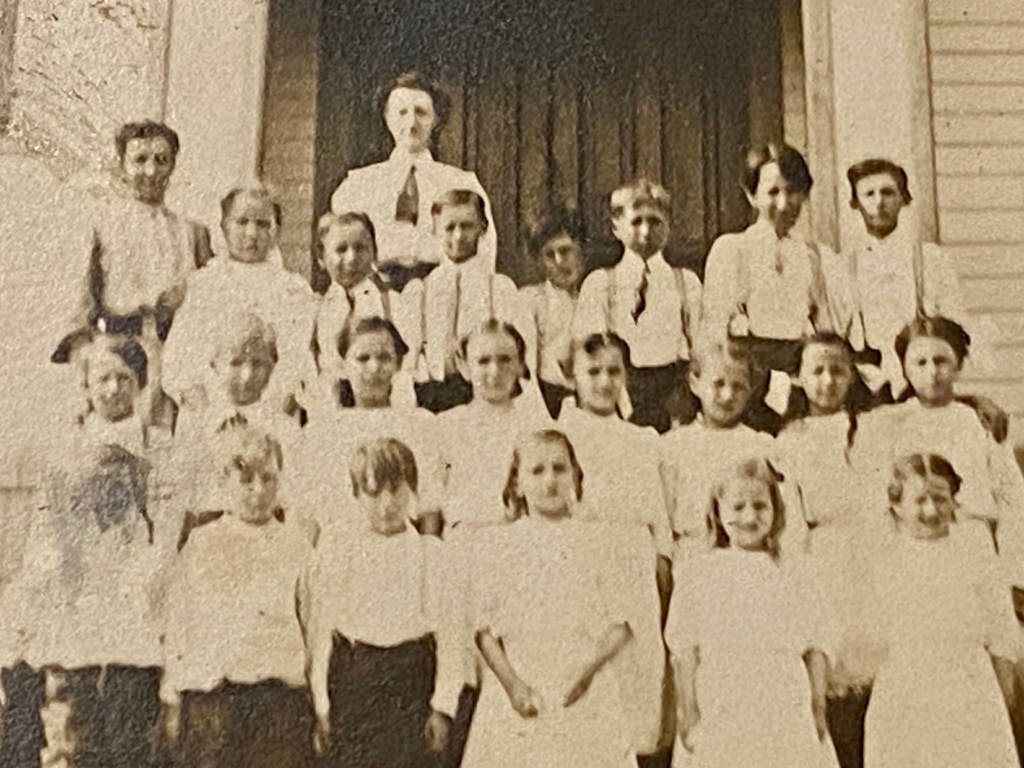
A picture of students at the Maland School shows Margit (upper left) with her hands on her brother Ole’s shoulders.
When Gunhild was little she was more or less a tomboy. She liked nothing better than to tramp along in the woods picking berries or gathering nuts. One day she had come across Ole’s woodchuck traps and cam lugging home three half grown woodchucks. She had killed them but couldn’t get them out of the traps. When she had learned to read she became a real bookworm, so Gunhild and I did not have much in common while we grew up. I played with dolls until I was 14 years old. Then father talked me into giving most of my doll clothes away to a little neighbor girl. Many of the doll dresses I had designed and sewed myself. I guess Father thought I was getting too big to play with dolls. But I would still steal away at ties and again sadly tuck them snugly into their little homemade bed.
When Ole was little he was an easygoing fellow. It even annoyed Mother when for several days coming home from school Ole’s face and clothes were covered with dirt. Rueben Spande and Mervin Tangum, who walked past our place to school, ganged up and threw dirt at Ole from the plowed field. Father admonished Ole to fight back. He said, “Show them they can’t do this to you.” So the next day when they began their dirt throwing, Ole walked over to us girls saying, “Hold this, Margit,” as he handed me his dinner pail. Somehow he gave them both a licking. They never tried it again. They became good friends.
Sometimes everything seemed wrong to me. One of those times I had come again and again to Mother complaining about my troubles. When she got tired of straightening things out for me, she looked at me and said, “Nei, stakkars deg da Margit.” (Poor you) I didn’t like the way she looked at me and said that. I hesitated coming to complain any more. Sometimes I felt sorry knowing I had hurt Mother’s feeling by not obeying right away. Other times I felt misunderstood and hurt.
During the summer months Father was beautifying and improving our farm home. He used the scythe to cut the grass around and in our yard twice or more every summer. In the winter he trapped and hunted fox, skunk, and squirrel. He had a robe, 54 inches by 54 inches, made entirely out of squirrel pelts that he had skinned, tanned, and sewed together. Mother helped to line it with red flannel with scallops all around.
Mother was never really well but she did the milking and other chores and found time to sew, knit, and make hooked rugs during the winter months.
A brother called Halvor
born January 20, 1909
I remember one late fall something mysterious seemed to be in the air. When we came home from school, Mother would quickly put her sewing away and pick up tiny pieces of soft white cotton flannel. When asked what she was making, she would get a sly look and give an evasive answer.
One day during Christmas vacation while playing in the storeroom, my fondest hope was confirmed when I discovered a box full of tiny little garments. I knew this was a secret that I wasn’t supposed to know, but I was so full of joyful anticipation I couldn’t keep it to myself and asked Mother what those baby clothes were for. My heart sank when she said they were for little Orlando, a neighbor baby. But one day Mrs. Engh came again carrying her little black satchel. Our cousin Margaret Landsverk had come a little earlier. After a while Margaret took us children upstairs where she entertained us by singing and telling us stories.
After a long time we heard a sound. A baby? I can’t recall how Margaret managed to keep us from immediately rushing downstairs, but I do remember after what seemed a terribly long time, Father came upstairs all smiles, announcing that we had a baby brother.
I was ten years old and a big girl now. I didn’t ask questions as to where the baby came from. I was wise enough to know, but didn’t let on.
Ole was a couple months past seven years. When he heard he had a little brother he looked pleased and said, “Han kommer vel te aa dalte ette meg han.” (He will most likely come toddling after me.) And I guess that was pretty much so, when this baby brother grew bigger.
This brother was called Halvor Lenard. Now we were four. Each one of us bore one of our grandparents’ names: Halvor and Margit Landsverk, Ole and Gunhild Oian. Some of our neighbors pitied us for having such common old Norwegian names, and at times maybe we ourselves wondered if it wouldn’t have been more glamorous to have one of those tongue twister names as Father called them.
Halvor grew and seemed healthy in every way except he didn’t urinate sometimes for two days at a time. He perspired so his pillow was wet. Mother and Father worried that something was wrong with his kidneys. When he was three months old they took him to Dr. Gunderson in La Crosse. He put his hand on his chest and immediately diagnosed it to be “den engleske sjuken” (the English sickness), now called rickets. The only remedy known then was to feed him unboiled whole milk mixed with raw egg yolks diluted with water, according to his age. Also to keep him in the sun as much as possible. Cod liver oil was not known to prevent rickets at that time.
I was at the age when a baby in the home was lots of fun, but sometimes I got tired of taking care of him. When Halvor was one year old and I was 11, Mother had to have surgery for ruptured appendix. Halvor was afraid of Ellen Heglie who stayed with us. He wanted only to have me do things for him. I even had to sleep between him and Ellen.
After Halvor was born Mother was very sickly at times. She probably feared she would not be around to see her little boy grow up. So naturally Halvor became quite a Mama baby. He used to stand by her bedside asking hundreds of questions of all kinds which Mother would patiently try to answer. Among other things she explained about death and the hope that we all would meet in heaven. After thinking about this for a while Halvor said, “Eg vi liggie i kjista e deg eg Mamma.” (I want to lay in the coffin with you.)
When Mother at times felt better she took care of the little chicken. Halvor tagged along. He had noticed that Mother killed little chicks that were hurt or had a broken leg. “So they would not suffer any more,” she explained.
One noon when dinner was ready we all called and called but no Halvor could be found. Quite a while later he was found hiding away. He had hurt his foot and couldn’t step on it, and he was afraid he would share the fate of the chicks.

In 1990, Halvor points out where he had hidden back when he was so young.
When we got candy we all made it last as long as possible by only licking on it. Halvor was able to save his for days. Then every once in a while he would come around with a pleased look, licking on one of his hidden treasures.
Next chapter: Other Relatives
 Margit Mindrum