
Breaking Loose
I was lonesome for other young people. We were only allowed to exchange visits with our girl friends every other Sunday afternoon. The other Sundays were to be spent with our family at home. Father said the more you get to go the more you will want to go. Occasionally, when some of the neighbor girls my age called and wanted me to walk with them to Highland or Choice, Gunhild was always sent along. I was considered too young to go alone and so if some boys came and walked with us it was reported to my worried parent by my little sister. I remember pulling and jerking on Mother’s so-called apron strings, but Mother never budged. I was much older before I realized that our home was a good home.
At that time there were church services every two or three weeks. On the alternating Sundays, Mother would faithfully sit down and read in the hymn book. Father would rather take a walk in the woods. I liked nothing better than to listen to Father and neighbors discuss the Bible. I was often amazed how many Bible passages Father could give as proof for his belief. He had a very good memory for history, including church history.
Sometimes during the summer months when the horses had worked hard in the field all week, we youngsters walked across fields and pastures about two and one half miles to church. Sunday at hoe was a day of rest from the week’s work. Mother always saw to it that there was a good supply of pop corn on hand to munch on while reading the several good Norwegian books and magazines.
I was gradually settling down learning to enjoy the peaceful life at home. Ole was doing well in high school. He brought home a crystal and some copper wire and ransacked Mother’s cupboard for empty baking powder cans, etc. He had the idea how a radio could be put together.
Around this time we got a lawnmower. Now Father landscaped and beautified our lawn with flowers and shrubbery. Visitors who came said our yard looked like a park.
Many other improvements had been made. The barn had been remodeled. New machine shed, new corn crib, new chicken coop, and new kitchen had been built. A stone milkhouse was built over a large cistern to hold water piped from the well and windmill.

Young people relaxing on the lawn at the Landsverk place
Father found time to write letters to friends and relatives. He also wrote poetry for special occasions. In the winter months he made some wood carvings and paintings. He was a lover of nature. He went for walks in the woods where he said he felt close to God.
Although Father had never been a very robust or strong man, he could boast that he had never stayed in bed one whole day until he was 85 years old.
When Mother’s work was done for the day she liked to sit down and read Og ved Arnen, but soon the paper would slide down and nod, nod went her head. It was cheerful to wake up in the morning and hear Mother singing while she prepared breakfast. It was always ready before six. I felt very embarrassed if Mother called a second time, “Nei, Margit, klokka gaar te sju.” (No, Margit, the clock goes toward seven.) It had usually just struck six. But it was a firm rule at our home that no one sat down to eat until everybody was dressed and ready to eat.
By the time I was 19 years old I had become perfectly happy and satisfied to stay home. Father and Mother would now sometimes have to coax and encourage us to walk to Luther League at Highland Prairie Church. I would much rather stay home and read. I felt shy and self-conscious when out among young people.
I had all through my childhood years admired large families. My secret ambition was to have at least eight children. I hadn’t given much thought that a father and husband was necessary. But as I grew older and still dreamed about a large family of my own, it became quite a problem because now whenever boys talked to me I became uncomfortably shy and couldn’t think of a thing to say.
That winter a young couple in our neighborhood needed a hired girl. Mother and Father thought it would do me good to get out and work and also earn some money.
Every spring the young people in the Maland school district put on a play and basket social. I had never taken part before, but now I was more on my own and went along. We practiced twice a week.
I soon learned to enjoy coming together with other young girls and boys, and sometimes let the boys take me home to the place where I worked without having Gunhild as chaperon.

The Maland School
The Maland school burned down that year, so we gave the play in the town hall about three miles from home. That evening a neighbor boy named Palmer who had walked me home a couple times took me home in his single buggy with a horse named Bonnie.
Later that spring I came down with inflammatory rhuematism. I had to stay in bed one month, and was advised by the doctor not to go back and work at the place because the mother had tuberculosis.
A couple months after I had recovered, a banker and his wife who were friends of Mother and Father asked if I could work for them in Rushford. They had two girls, three years old and four months old. This was my first experience living in a modern home with electric lights, running water, bathroom, ice box, electric washing machine, furnace and car. The work was easy but everything was strange. Having people around wherever I turned made me homesick. My comfort was Mother’s sister, Gunhild Halverson, and her husband and family. They invited me to spend my space time in their home. They introduced me to their friends, and made me feel like one of their family.
This was the eventful fall of 1918: Mother and Father bought their first car, a new Chevy. The dreadful flu epidemic took its toll. World War I came to an end with the signing of the Armistice on November 11. I remember the joyful excitement. The family I worked for made a dummy as a replica of the Kaiser Wilhelm. It was dragged after the car as we drove around town.
I had been working in town six months when I went home for Christmas vacation. On New Year’s Day in the evening, one of our neighbors gave a party. All the young people around the neighborhood were invited. By the next evening most of us were in bed with the influenza. I was the only sick one in our family, but in some homes everyone was sick. The few in the neighborhood who had escaped the flu tried to help out with chores but many did not dare go into the house to attend to the sick. When I had recovered some, Mother and another neighbor lady went to help out in a home where a young girl had died and all the others were sick. While I was getting better I’m sure no one guessed how I felt. I was disappointed and tired of life. I had prayed that I too might leave this world. Heaven seemed so peaceful, but it was God’s will that I should recover.
Although I had learned to like Rushford and the people where I worked very much, it was decided that I should stay home that spring. Gunhild went out to work the next summer. In the fall she came home and I went to work for Uncle Henry Oian. His wife had passed away from the flu, leaving three children. Their ages were 4, 8, and 11 years.
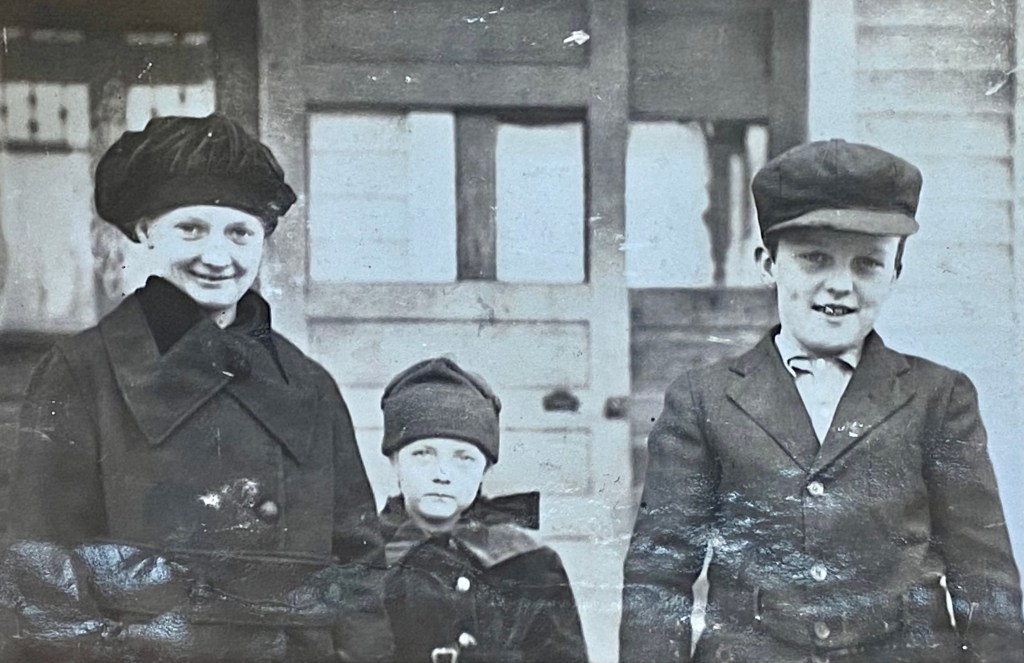
Uncle Henry’s children had lost their mother to the influenza epidemic before Margit came to take care of them. L-R: Marian, Ruth, and Clarence.
Below: A farm identified as an Oian place on Oian Ridge near Peterson MN. Margit’s mother, Helga, was an Oian.

I learned a lot there and it was a good feeling to try to be a mother for those children who had lost so much. Uncle Henry was a kind and understanding father and uncle. While I was there I learned to like all my Oian uncles, aunts, and cousins. We had many parties and family gatherings. They were jolly and fun loving. We had lots of fun playing games and tricks when we came together.
Gunhild was by this time engaged to a handsome young man from Neilsville, Minnesota. Ole had entered Luther College. Many of our friends hoped that he would go into the ministry. I had about given up all hope of ever having a family of my own.
When I had been at my uncle’s home in South Rushford almost two years, I received a letter from the boy who had taken me home after play practice a few times. I believe my heart stood still for a moment, because I knew I had liked this boy very much. But the summer after play practice he had met a girl at the place where he worked. They had become engaged. When she found she had tuberculosis, he had gone with her to Colorado.
Now he wrote that she had broken their engagement and he would like to know if I still was free.
What should I do? Answer or not? My heart pulled one way, my reason pulled the other way. I couldn’t sleep that night. I prayed over and over for guidance. In the morning when I woke from an hour’s nap, it seemed clear and right for me to answer him that I would like for us to be friends.
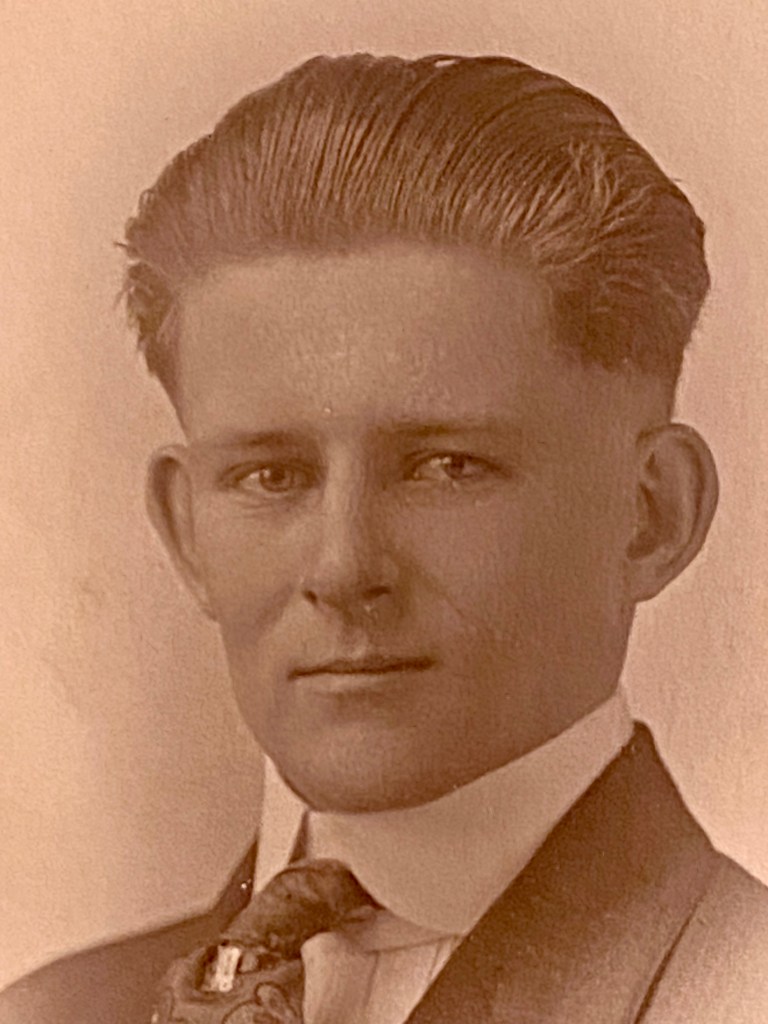
Palmer Mindrum
Next chapter: Courtship and Marriage
See also Margit’s early letters with Palmer
 Margit Mindrum