
Bratsberg
(a.k.a. the Rorhella farm, spring ’28 to spring ’35)
After six years at my home place we had a chance to buy an 80 acre farm north of Bratsberg. In 1928 $10,000 was a steep price but the house was clean and newly papered and painted, the barn had been modernized with stanchions and manure carrier, the fields were in real good shape with a good stand of alfalfa. It looked promising.
Now we had a farm of our own. We felt on top of the world. Arne, our third boy, joined us the first winter. He was a husky, curly haired little fellow.
By skimping and saving we were able to meet all payments and interest the first three years. Suddenly the bottom fell out of everything. Milk cows that had sold for $50 to $60 had to be sold for $9 to $11. We sold 200 pound hogs for four to five dollars each. Interest and other payments stayed the same as before. The State took over our farm and let us rent it reasonably. To top it off, the stork had got its eye on us. Twins were added to our family. Ellert and Ellen were a real joy as they played contentedly together. A year and a half later Frieda, a wide-awake little girl, also came to make her home with us. Our family had doubled in less than five years. Now we were eight around the table.
For a more detailed account of Frieda’s entrance, see The arrival of Margit’s last born.
The farm is a good place for children to grow up: fresh air, animals and pets to love, lots of space to run and play. We had milk, butter, potatoes, vegetables, strawberries, and raspberries. We picked black caps and gathered nuts in the woods. I did not list eggs because they were often the only means by which we could trade for sugar, coffee, and kerosine for the lamp and lantern. We ground our own corn meal and wheat for cereal for sorghum syrup.
It was heart-warming to see the children smack their lips and enjoy this plain home grown food. They all grew healthy and strong, ready to romp and play at all times. We had to remind them to do their little chores around home and to study their catechism.
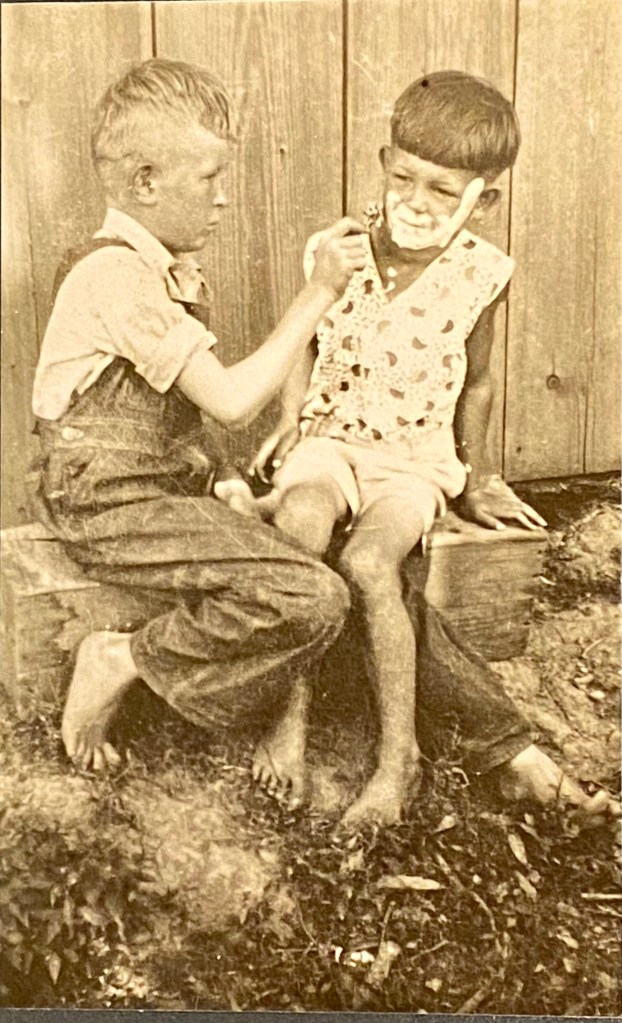
Paul “shaving” Alf
Everybody in the neighborhood talked Norwegian. When Paul started school he could talk only Norwegian. The first summer Paul and Alf attended parochial school the elderly teacher did not think anyone could get the true meaning of God’s word in English. She had them learn the lesson in both English and Norwegian. The next summer a young seminary student was hired to teach. He claimed it would be better to have the children memorize it thoroughly in the language of the country and so the Norwegian A B C book and the Norwegian catechism were laid away.
Palmer had a good loud voice. He sang when he came in for meals. He sang while he was doing chores, especially when milking. He sang hymns and tunes popular at that time and he sang parts of Norwegian songs and ditties. When a dance tune came over the radio he would pick up one of the little ones and go dancing around the house. Frieda would flash a broad smile whenever he sang “Little girl dressed in blue.” That was her song. He also had a sing-song voice when at night before going to be he faithfully read the long Bible passage and sermonette in our Norwegian devotional book. I confess I sometimes had to fight sleep and did not always get much out of it. The thought that God would have us read and meditate on his word every day gave me comfort.
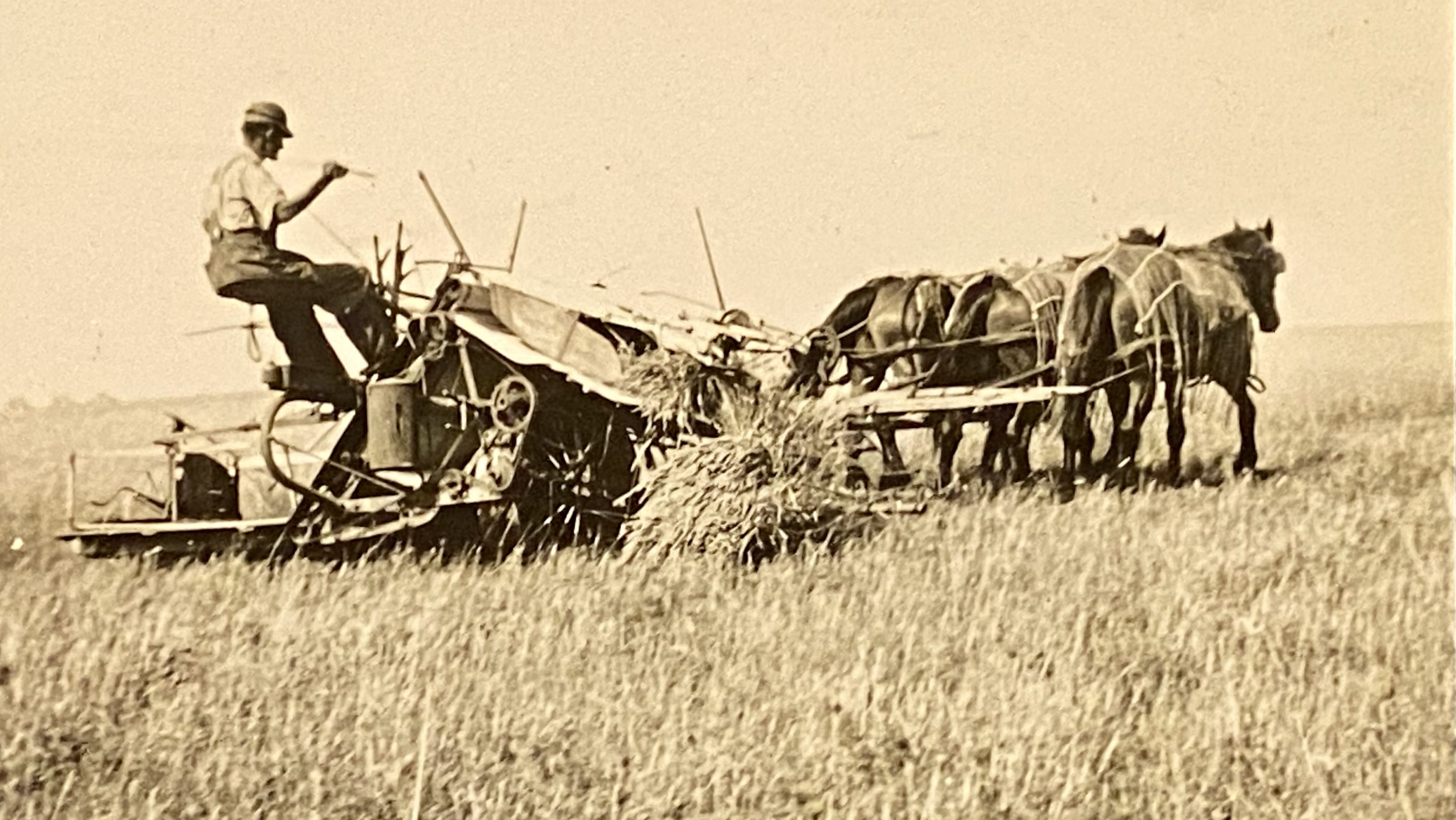
Palmer harvesting on Highland Prairie
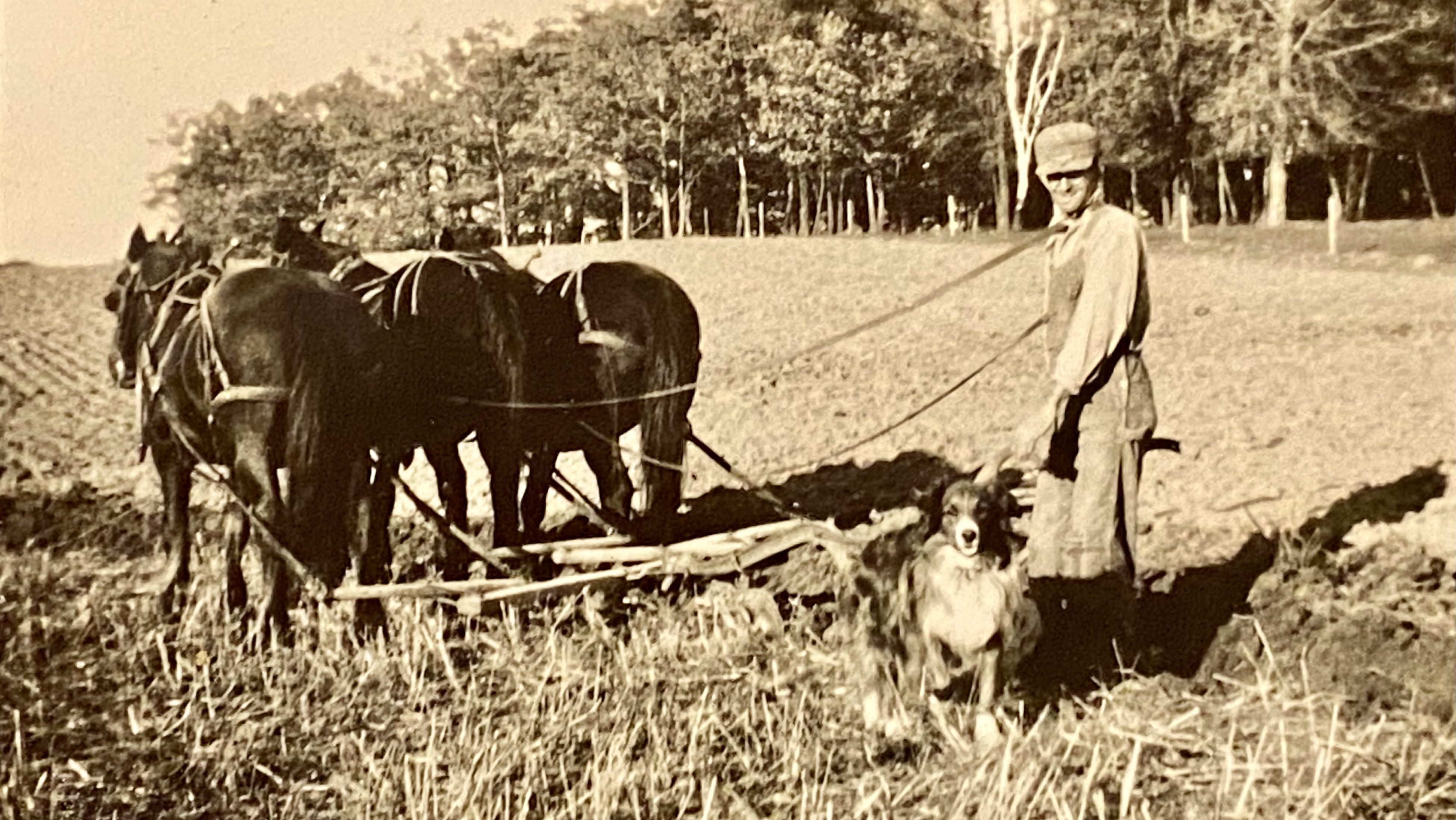
Palmer behind a plowing team
Palmer was a strict disciplinarian. He made the children toe the mark. He probably judged a bit hasty sometimes but made up by finding time to play, joke, and laugh with the children. I sometimes hated myself for not being able to be more patient and consistent. I prayed but God seemed so far away. I sometimes wondered if it had been just a childish illusion that made me feel that God answers prayers.
One day while helping Paul with his lesson we came across the passage, “For I do not do the good I want, but the evil I do not want is what I do.” It struck me that if Saint Paul could feel helpless, what about me? My mother loaned me a book “Hjelp for sogende sjale.” (Help for seeking souls) It strengthened my faith that God does love and care for us.
During the Depression it had become the custom around the neighborhood to share outgrown and cast-off clothing with families who could make use of them. This was a great help for big families.
The largest woolen garments I took apart, washed, turned inside out and made suits, pants, coats, and dresses to fit the sizes of our children. They often looked like new.
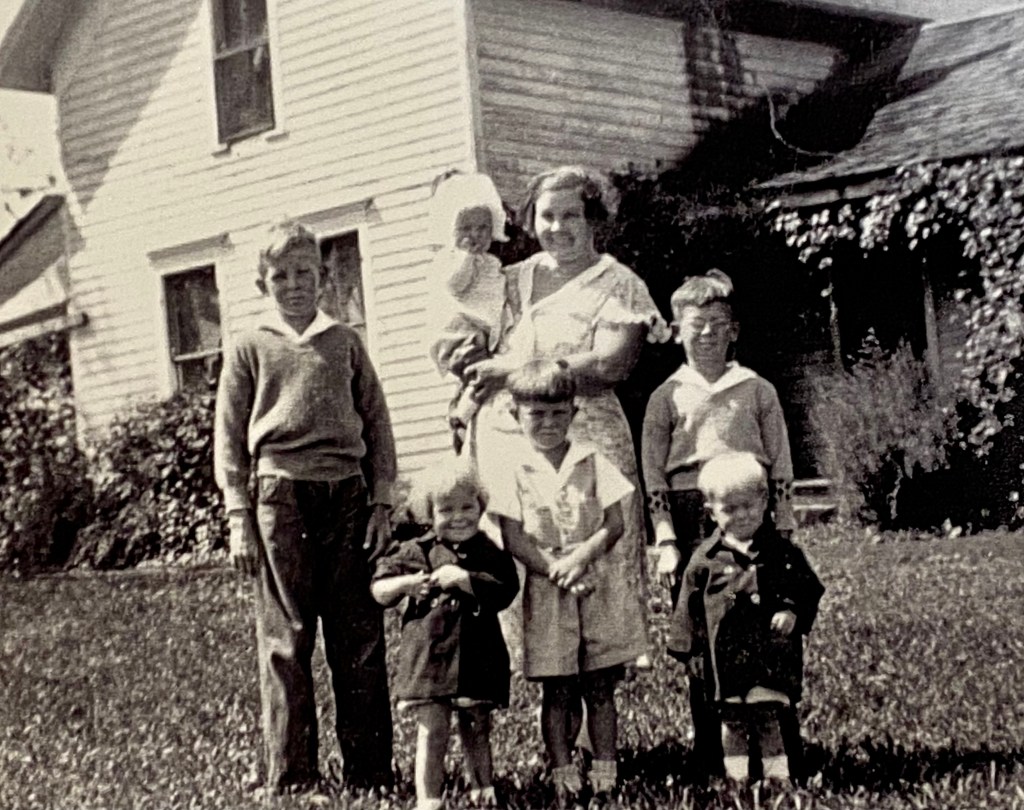
Margit and her six children at the Rorhella farmstead, near Bratsberg MN
Three of our boys were now in school. The teachers at the Bratsberg school invited the mothers to come to school and watch the children perform and to see what they had learned. Palmer took me and the little tots over that fall when Arne was five years old. Arne was very interested in the first grade materials and books. The teacher seemed to enjoy his enthusiastic talkativeness. Next Monday she sent a note home with Paul and Alf inviting Arne to come and visit school whenever he could. Arne was big and strong for his age and eager to go. The teacher continued to encourage him to come. He went most all winter. She passed him to second grade.
It was one of our big mistakes to let him go into second grade before he was six. When he got to fourth grade he started having trouble keeping up but we couldn’t convince him he would be better off going back one grade. It made it hard for him all through high school.
Next chapter: Oak Ridge
 Margit Mindrum