
(Highland Prairie, roughly ’22 – Spring ’28)
My dream of a permanent home where our children could grow up did not materialize. We moved nine times during our 53 years of married life. It had its rewards. We met good friends wherever we moved whose friendships we still treasure.
Palmer and I grew up with slightly different backgrounds. My parents married when they were in their thirties. I was the oldest child. We were more or less sheltered from this cruel world while growing up. Palmer’s mother died from tuberculosis while he was still an infant. He and his four year old sister were brought up at their grandparents’ home among teenaged uncles and aunts. When Palmer was around 15 years old his grandparents retired from farming and moved to Rushford. His uncle Otto and wife Olga moved to the old farm. Edward, Palmer’s father, had remarried and moved to Osakis, Minnesota.
Palmer felt that he had lost out by not belonging to a family of his own. His aunt Gina, who had stayed home and helped her parents raise Ella and Palmer, was married to Oscar Anfinson. They offered that if he would help with chores and farming he could come and make his home with them. He lived with them for couple years. Oscar and Gina were like a father and mother to him. They had two little boys, Olaf and Ralph. Palmer has always felt like a brother to them. The Anfinson home was located about a mile southeast of my home place. Gina was probably my mother’s closest friend in the neighborhood. After we were married the Anfinsons treated me like a daughter.
Palmer had learned to mingle with grown up people and matured at an early age, sporting girls and considering himself a good dancer. He and several cousins and friends used to go to small house parties, mostly at relatives homes. Palmer and I were present at a few parties after we were married. I did not have dancing feet so some of us played whist. Baby sitters were unknown. We brought our little ones along. There was always an accommodating bedroom for several sleepy heads.
When we began our farming career we looked ahead with confidence and the optimism of youth. Palmer was outgoing, quick-tempered and full of life. He had big dreams of going into more modern farming than the practice was in the neighborhood. We rented my home place at $700 a year. We borrowed $1,000 from my parents to buy out their farm machinery and livestock. They built a new home on the farm one fourth mile away. They were eager to help us out with work and they meant well. But misunderstandings arose, maybe caused by the generation gap.
Father had kept the barnyard and apple orchard like a park. We hadn’t stopped to think how much work it had been until we had been there couple years. We found the currants and gooseberry bushes almost hidden in the tall weeds.
Our lives were filled with love, joy, and happiness. Our special joy was two little boys. Paul, a fair haired boy, enjoyed his toys most by keeping them nice and in order. Alf, one and one half years younger, was a smiley darker complexioned little boy. He put his toys to hard work. They both loved their Grandpa and Grandma Landsverk. Whenever they came over, the boys would climb up in Grandma’s lap, put their arms around her neck and say in Norwegian, “I want to hug you, Grandma. I want to kiss you, Grandma.” Grandma shyly enjoyed their caresses very much. The boys had two kittens named Rollo and Mons, and a dog, Snap.
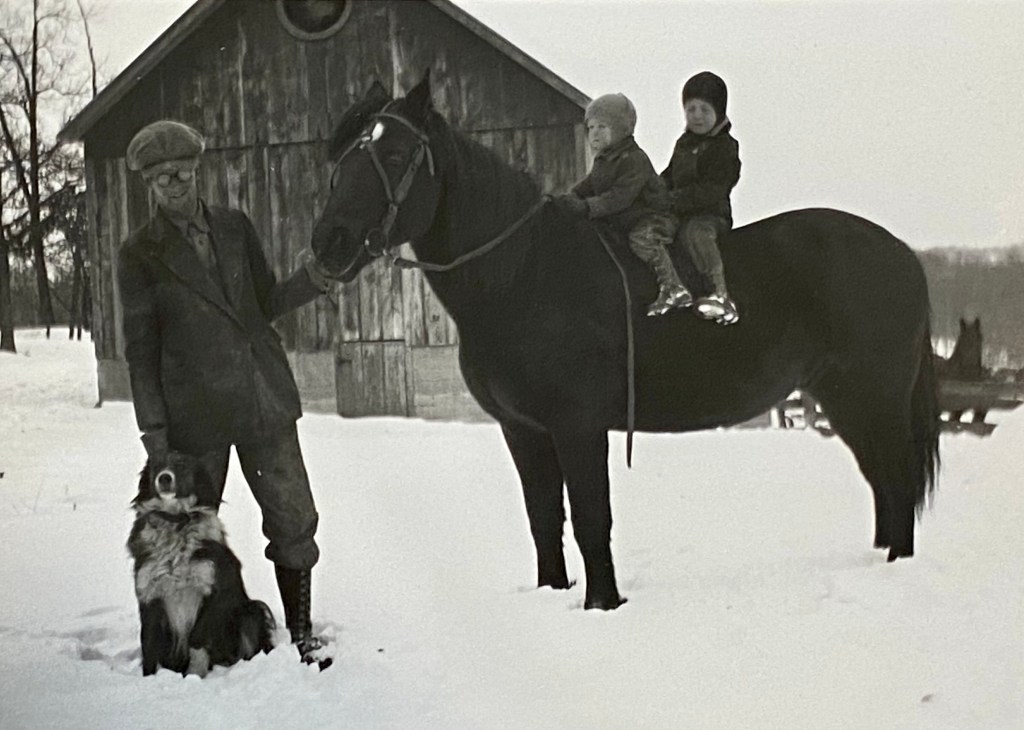
Palmer with his sons Paul (at right) and Alf at the farm of his father-in-law, Tarkjel Landsverk
We had few conveniences in our home and the boys did not have many playthings. Most were homemade and made to last. If accidentally broken, Palmer would repair them. I scrubbed clothes on a washboard, boiled the white clothes in a boiler on the wood cook stove. I made use of the hot stove by baking a batch of bread at the same time.
Several young couples in our neighborhood started out in life under similar circumstances. Having few earthly possessions did not dampen our happiness. We shared each others good luck and disappointments.
We enjoyed a happy social life with all our friends and relatives, visiting back and forth. Church services were every other Sunday. Rev. Magelssen served three churches. Mother almost always asked us to come and have dinner with them after church.
I was trained from home to help with chores and field work. Palmer had not been used to having women folk help in the barn and hesitated to accept my help at first. It didn’t take long before he depended on it.
The first years we took the boys along to the barn while milking. There were baby calves, kittens, and other things to keep them busy. One evening three year old Alf had come too close behind the cow I was milking. The cow coughed and Alf was plastered head and shoulders. Palmer finished the milking.
One summer evening the boys were playing outside the barn when a man with a long beard, a friendly smile and kindly voice stopped to talk to them before coming in the barn to talk insurance. When he left Paul asked, “Was that God?”
Chorsing [doing chores] can be both pleasant and tiresome. Words can’t describe the fresh beauty of an early sunrise, sunbeams sparkling like diamonds in the tree tops. It is even exhilarating on a cold winter evening to walk in the crunchy snow with only a lantern to light the path from the barn. What a good feeling to come in from zero weather to the warm kitchen. That is until two little boys had been helped out of snowpants and overshoes and I spied a dishpan full of unwashed supper dishes.
When we had been married 2 1/2 years my sister Gunhild’s good looking suitor from Neilsville, Minnesota, decided it was time to get married and came to claim his bride. They were married in September at our parents’ home in a small but pretty wedding. Ole had graduated from Luther College and was teaching. Halvor helped my parents as they raised couple acres of tobacco every summer. Mother was very anxious that we stay on at the home place but we had bad luck the last years. Bangs disease got into our cowherd. We lost all the calves and most or the cream checks. The next year we lost several pigs from hog cholera. It seemed that maybe we ought to make a change.
Next chapter: Bratsberg
 Margit Mindrum