The following account was compiled from the oral history and written notes of Margit, her son Paul, Frieda herself, and others involved.
<< | Bratsberg | >>
Lean years
In the farmhouses and small communities of SE Minnesota, the year 1933 was the depths of the Great Depression. Margit and Palmer’s growing family had survived the first years of the country’s financial meltdown. Back in the spring of 1928, when times were good, they had sprung for a new farm, paying a stiff price for their 80 acres. But the farm seemed a good investment, with many modern amenities for the Highland Prairie area. And a year and a half later, when the stock market crashed in October of ’29, the effects weren’t initially felt up on Highland Prairie.
But it was several years into the Depression now. The bottom had fallen out of the market.
Months ago, when Margit first found out she was pregnant, she cried for days. This was not a good development. She was already the mother of 5 children aged 10 and under—including twins who were only 18 months. This would be their sixth child. And the concern wasn’t only financial.
Margit’s daughter Frieda explains: “It wasn’t that she didn’t want another baby. Her early ambition was to have eight. She and Dad could name five families where either the mother and/or baby died when the baby came so soon after twins. The thought of leaving five children motherless was not a pleasant one.”
Margit’s oldest son, Paul, talks about his feelings at the time: “In trying to put the memories of a ten year old brother into words, I somehow don’t come up with blissful anticipation of another baby sister or brother. This obviously meant another baby, that I would have to help Mom with.”
That memorable night
On the evening of July 1st, a Saturday, Margit realized the baby was coming. She knew what they had to do. They had to reach the hospital down in Spring Grove—the same hospital where the twins, Ellert and Ellen, had been delivered. (Her three oldest boys had all been born at home.)
And a storm was whipping up. Strong winds, sheets of rain. But they had no choice. Palmer and Margit left the other children at home in the care of a teenaged babysitter. He bounced their car, borrowed from a cousin, down the farm’s long driveway and then turned onto the roadway heading south. From their farm north of Bratsberg, the hospital on the south side of Spring Grove was a good 30 miles away.
Their eldest son, Paul, was 10 and a half. He writes, “I have vivid memories of Mom & Dad taking off for Spring Grove in George Oian’s Model “A” Ford during a terrible summer storm. Eighteen year old Alice Nordness was left to stay with us kids. In the evening her boyfriend arrived in his Model “T” to stay with us. He slept on the kitchen floor. I was glad he came; under the circumstances I wasn’t ready to be the man of the house.”
Meanwhile, on the road
With Margit in the passenger seat, Palmer raced through Bratsberg, then through the town of Choice. By the time they reached Tawney it was pouring rain and hard to see out the windshield. (Note: All that remains of Tawney now is a marker in a small roadside park.–Ed) Spring Grove was still about a dozen miles away.
Later, Palmer recalled a scary night of driving as fast as he safely could. But the details of the trip blurred like the rain splashing on the car’s windshield. And the rest of the night, like what happened at the two-story brick hospital in Spring Grove, mellowed into the comforting realization that he had done all he could do. It was up to the doctor, nurse, and of course Margit.
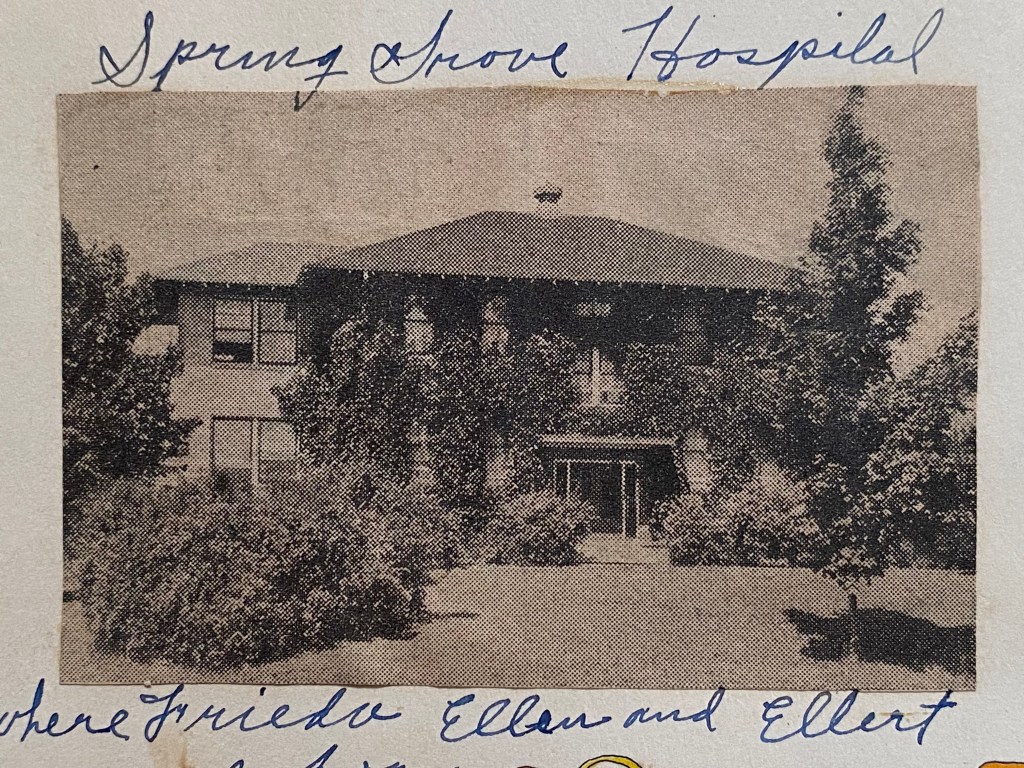
A vintage photo of the hospital in Spring Grove, Minnesota. The building still stands but is used for senior housing now.
In a bright and dry hospital room Margit finally delivered around 7 o’clock the next morning. The baby girl, who wouldn’t be given a name for another four weeks. weighed in at 8 1/4 pounds.
After the storm passed
When the new day arrived, things were a mess back at Palmer and Margit’s farm. “The next morning was bright and clear,” Paul writes, “but there was damage and destruction everywhere.” Trees were down all over, The brooder house had been blown away. Dead chicks littered the yard. “I remember we were busy trying to clean up some of the mess, when Dad came home and told us we had a new baby sister.”
The sun shines
Yes, the sun came out, and one more baby had safely arrived in the world to make Palmer and Margit’s own brood of children an even half dozen. Paul writes, “The summer of 1933 must have been at or near the low point in Mom & Dad’s farming career, and Frieda’s arrival was undoubtedly the single bright spot of the year. Starting with this stormy arrival, many pleasant and happy family memories come to mind. Frieda has invariably been the happy girl who has brought out the best in everyone around her, including her old brother.”
Back to the Children chapter. Or…
Back to the Bratsberg chapter
 Margit Mindrum