In Margit’s world it’s not all blue skies
<< | Paintings | >>
It’s rare to find a cloudless sky in Margit’s paintings. Usually it’s a pale haze or cloudy. Sometimes there are even storm clouds. But Margit also experimented with pink (and orange) skies. Here is a progression of paintings that seem related as she practiced mixing colors to create the evening sky she saw.
Note: Some of this is conjecture because we haven’t positively identified a few of the paintings. But it makes sense. 🙂
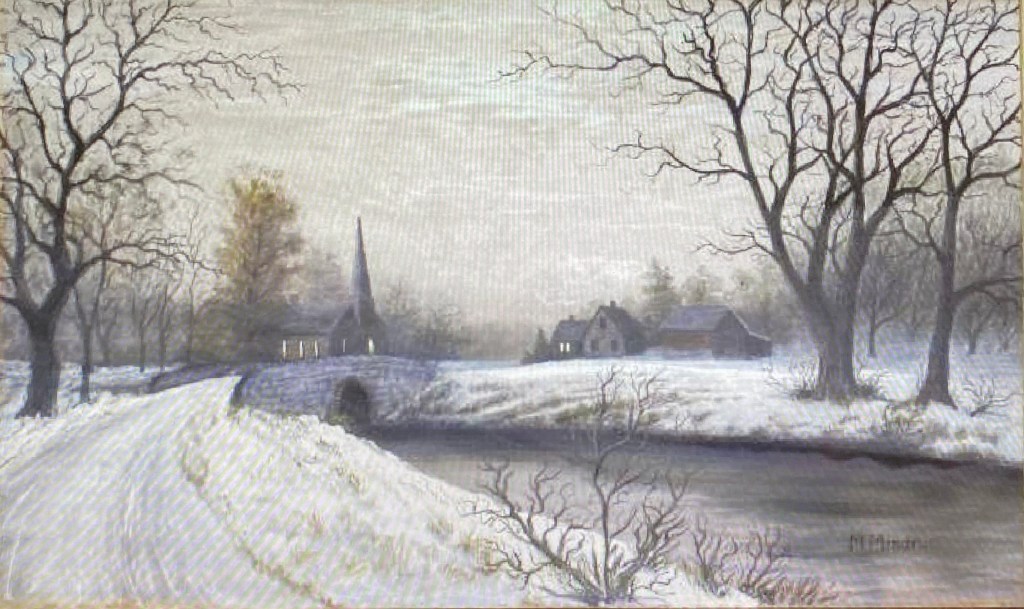
ID: ??? — possibly 64-03 “Pink sky water” (18″ x 24″)
This photo is several generations removed from the actual painting. As we’ve seen elsewhere, the camera often loses the original color. So we’re assuming it looked more like later paintings in this series. With the lit windows, it’s clear that it’s no longer daytime. But it’s not a dark night either.
This painting was found displayed on the internet from a recent online auction (spring 2023, in Kansas City MO). The auctioneer called it “Victorian”. It’s true, the stone bridge and gray-ish color isn’t Margit’s usual style. Even if the lights are on at both church and house, the scene looks cold and foreboding.
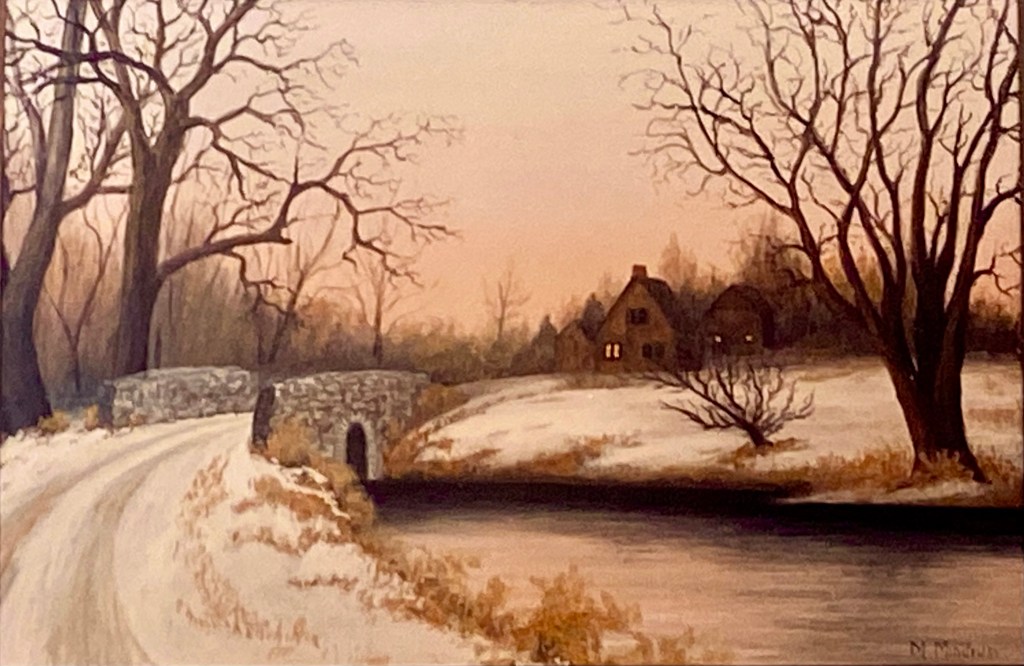
ID: ??? — possibly 64-08 “[Eac.?] glo pink sky” (18″ x 24″)
The church is gone now, but the stone bridge (a rarity for Margit) and other buildings are still there. A bush in the foreground has jumped across to the far bank, which IMO is an improvement.
What’s noteworthy here, of course, is the sky. This is probably what Margit was focusing on primarily. The house’s glowing windows are there just to reaffirm that it’s after (or maybe before?) daylight. It still looks like it could be out of a Dickens story, though. Or maybe Edgar Allan Poe?

ID: 64-09 “Pink sky reflections” (16″ x 20″)
This is likely the culmination of Margit’s work on a pink sky — hence its name. (And even here the original painting is better than this image).
Here the bridge is no longer a distraction. And the water has been expanded so it can reflect on the house with the bright yellow windows that speak of people warm inside.
This is no lake or river. Finally the snow is melting. And true to form, regardless of the body or water, where Margit can show a reflection to convey wetness, she will—even if it’s flooded fields. Here’s what an art expert said about this last painting:
From both an artistic and technical standpoint, this is perhaps the most completely successful work in the exhibition. Detail is executed with consistently delicate brush strokes that relate well to the remarkably soft shading of the pink and blue ground. It is especially remarkable for its comparatively early date.
Dr. Marion Nelson, “Three Landsverks”
 Margit Mindrum